

Women, Peace, and Security (WPS) in US Security Cooperation
edited by Susan Yoshihara
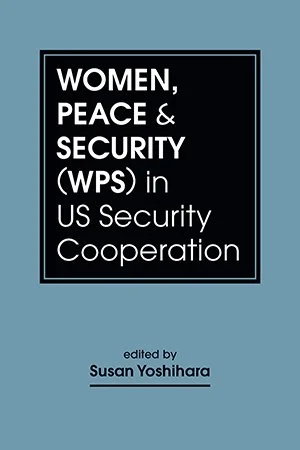
Women, Peace, and Security (WPS) in US Security Cooperation is a groundbreaking book, edited by Dr. Susan Yoshihara, ACWPS Founder & CEO, compiling chapters from authors who explore the origins, rationale, and evolution of Women, Peace, and Security (WPS) efforts in the context of US security cooperation. Focusing on real-world policy and practice, they draw on cases ranging from post–World War II Japan to contemporary Ghana to demonstrate how including women in security cooperation efforts, while not without challenges, has improved operational effectiveness across the US military, built better security relationships, and advanced civil-military relations and human rights.
WPS in US Security Cooperation is now available for purchase through Lynne Rienner Publishers.
Reviews of Women, Peace, and Security in US Security Cooperation
“A novel and policy-oriented contribution.... [The authors] strengthen WPS scholarship by bridging the gap between theory and practice and by providing tactical depth through case studies that show WPS in action across varied contexts.”
—Sandra Biskupski-Mujanovic, Peace & Change
"This important, thought-provoking work powerfully captures the successful US strategic policy initiative that established closer and enduring partnerships around the world through emphasizing the safety and security of women and girls in fragile, unstable, and violent societies…. It also raises practical, affordable, and effective policy ideas for decision makers."
—US Ambassador Donald Yamamoto
"Important reading for serious national security experts. For too long, we have viewed security only through the lens of lethality and battles to be won, [but] what's also important is the preservation of the peace, the reduction of violence against women and children, and the ability to restore long-term stability once the fighting is over. This book provides the theory, the history, and lessons learned for WPS. The theory is that when women are included in security affairs—both in planning and operations—we are more likely to be successful at preserving peace and restoring stability. The implications of that for women in the military and in national security leadership are profound."
—Lori Reynolds, Lt. Gen. (Ret.), US Marine Corps
Contents and Overview
-
Understanding the partner nation is essential to effective security cooperation. Yet how can DoD personnel understand a nation’s culture without the ability to engage the entire population, both men and women, and the sectors of the population for whom women are often caregivers, such as children and the elderly? As Shirley Graham and Nina Plateroti note, planners and policymakers too often assume that because women are not in public positions of leadership, their influence matters little. The perspectives and interests of women complement men’s perspectives and interests yet are often dismissed because accessing them is difficult where women are not in the public square, live in remote areas, or speak dialects other than those US forces can understand or translate well. This is not a uniquely American blind spot, and UN Security Council WPS resolutions recognize that a lack of comprehension of social dynamics has led to conflict, stymied peace deals, and reignited violence. The founding purpose of WPS in 2000 was to make the difficult endeavor of forging and maintaining peace agreements possible.
-
As LisaRe Brooks Babin notes in her chapter, when Operation Allies Welcome (OAW) commenced, the DoD had to recreate the teams through the memory and experience of individual WPS experts. Twenty years of applying WPS to ground combat in Southwest Asia left little time and attention for developing DoD thinking about its application in other domains such as space, cyber security, and maritime security and in the context of great power strategic competition. The contributors collectively demonstrate that the WPS agenda is not just a legacy of the “unipolar moment” after the Cold War in which the human domain rose to prominence in the UN Security Council and the United States undertook humanitarian interventions. To deftly wield the tools of statecraft in winning a strategic competition, the United States must open up new channels of communication in partner nations, and this includes women, who are key to promoting and preserving values in families and communities. Promoting the protection of women and girls and their opportunities for economic development in society advances American interests and the foundational values of republican governance.
-
Grace Hoffman’s examination of postwar Japan shows that giving women voting rights during reconstruction was an important part of the US plan to achieve pacification and democratization, its primary objective. American military victory and occupation facilitated those gains, obviously. But women’s gains were also possible because women’s suffrage was part of a broader pro-democracy movement in prewar 1920s Japan. Notably, when General Douglas MacArthur’s military administration promoted women’s suffrage in the negotiations for a new constitution, there was support as well as opposition from men and opposition as well as support from women. This shows that promoting WPS principles, mainly women’s participation in society, has historically been a political issue rather than a women’s issue. The Japan case also shows the effective influence of civil society movements.
-
A drawback to relying on expert advisors to conduct analyses is that other staff are not responsible for it and it is seen as “tacked on.” Polly Cegielski argues that because WPS capabilities were not embedded in security cooperation in Afghanistan, temporary successes were sporadic, even if some were notable. In a vicious circle, lackluster documented results led to a lack of support. No matter the strategic priorities, the contributors agreed that injecting WPS analysis early in the planning stages of an operation is essential if WPS is to be included tactically later on.
-
Security cooperation is about building relationships, which is ultimately a personal matter. Working with counterparts in the partner nation on a project, spending leisure time with a family, forging friendships and bonds that are not defined in official programs—these lay at the heart of building relationships among nations. Such efforts, however, are hard to put into words, difficult to measure on effectiveness scales, and often expressed in anecdotes. In her chapter, Dui Turner recounts the great lengths to which women in Colombia went to support one another, and she asks, if personal relationships are essential to national partnership, why leave women out? Conversely, Turner finds that women on staffs, mobile training teams, commands, and in other engagements with partner nations seized opportunities for new connections, and this reinforced American values and interests in a nonthreatening way. As Turner notes, overall relation-ships with partner nations in the US Southern Command improved when person-to-person relationships in Guyana and Colombia expanded to include women in the services. During her tenure as advisor, the US Southern Command was led by Gen. Laura Richardson and had a civilian woman as deputy commander. While it may not have been due to their sex, both supported WPS objectives in their high-level engage-ments and speaking opportunities. As a result, the command included women in a major exercise and highlighted WPS and women’s accomplishments in strategic messaging. Though China has been vying for influence in Latin America at Washington’s expense, it lacks such a capability. Turner argues that not excluding women has been a strategic advantage and it is arguably true that the connections made help expand security cooperation’s “scope, quality, and multilateral alignment.”
-
As Erica Courtney notes in her chapter, when Operation Allies Welcome (OAW) commenced, the DoD had to recreate the teams through the memory and experience of individual WPS experts. If advisors are employed in the future, their number, placement, and mandate should be based on how Congress defines the scope and purpose of WPS. The maximalist approach preferred by the Biden administration sought a large cadre of advisors to transform defense institutions at home and abroad. The WPS Act of 2017 does not call for any advisors and instead calls for training of “relevant” personnel. That training, however, may benefit from expert advisors in key positions. Erica Courtney argues that such advisors should be field grade officers due to their understanding of military culture and operations.
-
If DoD were able to keep the focus on men and women and stay within the mandate of the act, could WPS catalyze US security cooperation objectives? The cases in this book indicate that it would, where WPS has provided new capabilities in the current military and strategic context. The United States seeks access and influence by crafting a value proposition to attract governments by attracting societies more broadly. Rather than giving women an advantage over men, advancing the participation of women benefits all of society, according to the contributors. In his chapter on integrating women into the Ghanaian armed forces, Nick Tomb suggests the addition of women benefits all of society through the inherent ability of women to connect with other women, who in turn are caretakers for the most vulnerable and marginalized.
-
If the WPS Act of 2017 effectively sunsets, policymakers can still align and integrate its most effective capabilities into national security. An example is considering Mull’s proposed integration of WPS and CHM concepts in future research. The decision to leave the “prevention” pillar out of the 2023 US strategy on WPS resulted in a missed opportunity. The agencies can make up for this shortsightedness by reinforcing practicable WPS capabilities in atrocity prevention and other aligned efforts. In the meantime, WPS capabilities can be added in support of other policy agendas such as international religious freedom. Protecting religious minorities is included in the WPS Act of 2017, but too little work has been done to implement the mandate. Specifically, congressional committees, US agencies, and civil society can find ways to catalyze existing efforts toward implementing the International Religious Freedom Act of 1998 and the WPS Act of 2017.
The Future of WPS
From the concluding chapter written by Dr. Susan Yoshihara
The final chapter examines what lies ahead for the Women, Peace, and Security agenda in an increasingly complex security environment. WPS is not a standalone initiative, rather, as the book argues, a strategic framework that strengthens national security by broadening perspectives on conflict, civilian protection, and mission success. The conclusion also explores how political debates have reshaped perceptions of WPS, why preserving its practical and bipartisan foundation is essential, and how implementation must account for the unique cultural and social contexts of different countries. Looking ahead, the book calls for greater focus on where WPS investments deliver the greatest strategic value and demonstrates why integrating the human dimension of security will remain a critical advantage as global competition increasingly unfolds below the threshold of armed conflict.
As conflict changes, so must our understanding of security. At a pivotal moment for the future of WPS, the final chapter explores why its strategic importance has never been greater.


2025-2026 Book Tour Locations









Arlington Advisory Forum