
The “Butcher of Bosnia” got a Hero’s Funeral: What that Means for Future Wars
by Samantha Lakin PhD
On August 27, 2026, convicted war criminal Ratco Mladic, the “butcher of Bosnia,” died in custody. On September 3, 2026, he was buried next to his daughter at a state sponsored funeral in Belgrade, Serbia.[1] The former commander-in-chief of the Bosnian Serb army died in detention in The Hague at 84 years old while serving a life prison sentence. He was found guilty of abetting genocide in Srebrenica (1995) and numerous war crimes and crimes against humanity during the 1992-1995 war in Bosnia-Herzegovina. The venue was the International Criminal Tribunal for the Former Yugoslavia (ICTY)--an ad-hoc tribunal founded by the UN to try the individuals most responsible for the terrible events that took place in Bosnia.
“Transitional justice is not only about accountability for the past; it is also part of the work of building a more durable peace.”
Imagine the scene: soldiers from the Serbian Army carried his flag-draped coffin to the burial site. Several high-ranking Serbian government ministers attended, including leaders from Republika Srpska. Nationalist supporters filled the streets outside the cemetery to pay their respects to Mladić, international war criminal, who, in their eyes, was still a hero. This celebration was widely condemned except by Serbian President Vučić. He disregarded the criticism, defending the funeral as respect for the family’s wishes and cast the fanfare as a dignified burial rather than the glorification of a war criminal and mass violence. It was an affront to both survivors and victims.

Photo Courtesy of RadioFreeEurope RadioLiberty
Just weeks after Mladić’s death, former Kosovo leader Hashim Thaci was sentenced to 25 years in prison by a special tribunal in The Hague, the Kosovo Specialist Chambers. Thaci led Kosovo’s fight for independence against Serbia in the 1990s and was found guilty of committing war crimes, torture, and murder during the war. His trial lasted for three years, following a nearly six-year period in detention after his resignation from the presidency. Like Mladić’s trial, appeal, prison sentence, and burial, Thaci’s trial raised questions about the delivery of justice. One of the most contentious issues around both leaders is that both denied their complicity, deepening divides in their homelands between those who consider them war heroes and those who recognize the fact that they are mass murderers.
At first glance, the event of Mladić’s death and Thaci’s prison sentence feel like an unremarkable ending to these stories. Mladić himself may have been a banal person, except for the atrocities he committed in the Serbian army. Many of the worst perpetrators in modern history have otherwise been ordinary, Thaci, Eichmann, Akayesu, Assad. Perhaps dying in prison was a fitting although unsatisfying ending to this justice story. A forgettable human being deserves to be forgotten.
Importantly, the unfinished story of Srebrenica also illustrates an often-overlooked dimension of U.S. law on post-conflict justice, including the Women, Peace, and Security Act of 2017. The 2017 WPS Act calls for transitional justice and accountability mechanisms that incorporate the experiences and perspectives of women and girls. In Srebrenica, where thousands of men and boys were murdered and their bodies dispersed among mass graves, women were left searching for the missing, identifying remains, seeking acknowledgement and accountability, and rebuilding families and communities.
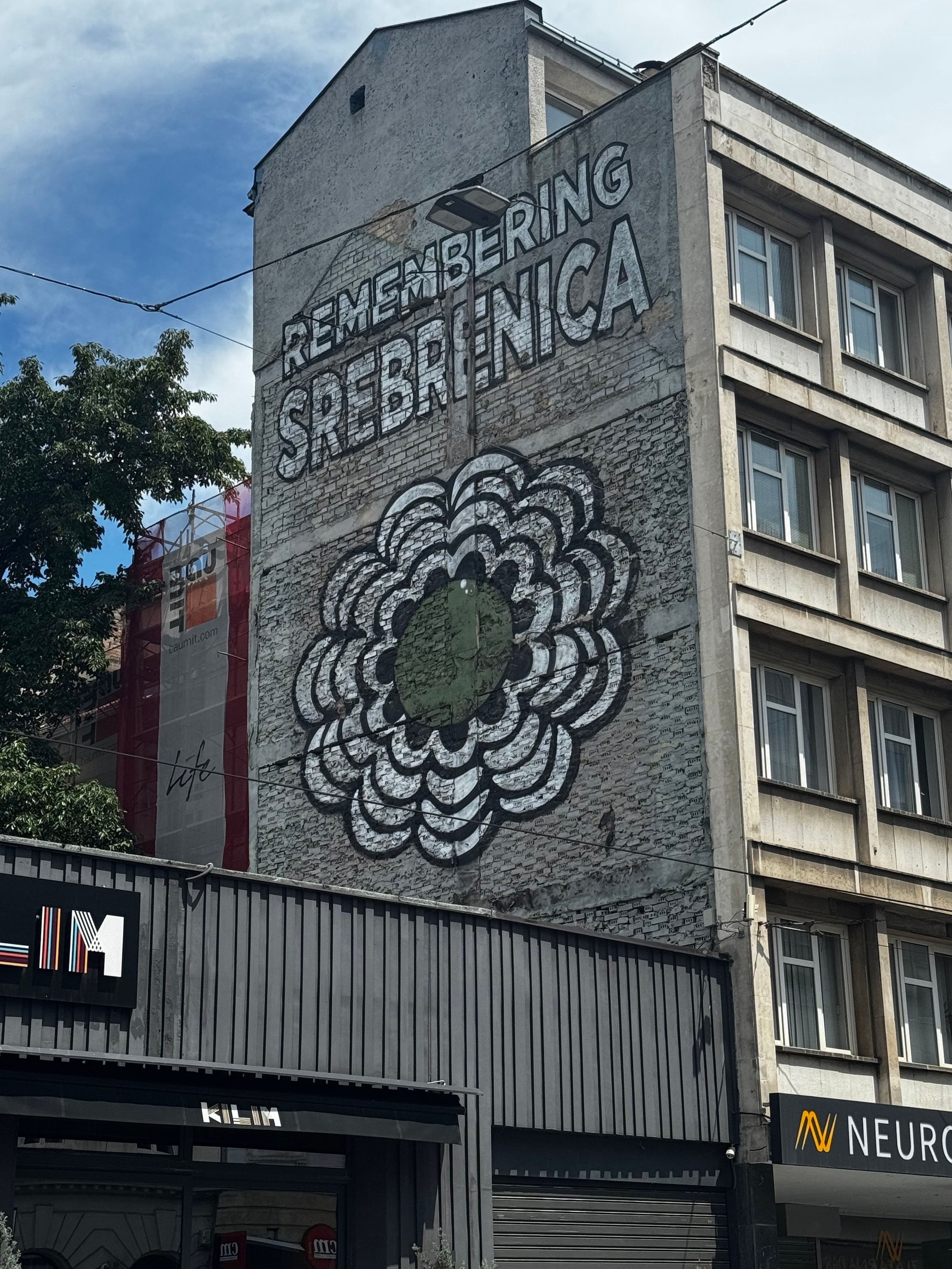
Photo by Pred Sek
The bereft survivors’ experiences demonstrate why transitional justice cannot end with the conviction and imprisonment of perpetrators. How societies remember atrocities, treat victims and survivors, recover the missing, and confront the glorification of convicted war criminals can shape reconciliation long after the fighting ends. In this sense, transitional justice is not only about accountability for the past; it is also part of the work of building a more durable peace.
Based on more than fifteen years of research with victim and survivor communities of atrocity crimes and genocide, I have found that dignified burial is one of the most universal needs among such groups. Many survivors are denied the satisfaction and closure that comes with knowing where their family members were killed and the possibility of burying them as a form of meaning-making and care-taking. In Rwanda, many victim’s bodies were thrown in toilets or deep pits or dumped in the Nyabarongo or Akanyaru rivers. Some survivors believe that their loved ones are still alive, as they have not found their remains. They say they will be haunted trying to find them until there is a conclusion: finding them dead or alive.
In Srebrenica, men and boys were detained by Serb forces and executed. Their bodies were buried in mass graves in eastern Bosnia. The perpetrators later used heavy machinery to remove the bodies from primary mass graves to secondary sites, sometimes fifty kilometers from the original execution sites. This orchestrated effort to conceal evidence of the crimes resulted in bodies being disarticulated. These efforts to cover up the violence resulted in a significant case of disappearances, with victim’s families still unable to find the bodies of their loved ones.
“The details of Mladić’s death in prison and burial feel like a wild-west ending to this justice story, one in which victims and survivors continue to be on the losing side.”
The symbolic violence, contradiction of historical narratives, and distortion of factual record displayed by Mladić’s burial and Thaci’s 25-year sentence is an added layer of injustice toward genocide victims and survivors. While victim groups in Srebrenica have been fighting for information, acknowledgement, and assistance that would allow them to locate and provide a dignified burial for their loved ones, Mladić received a state-sponsored, neatly facilitated funeral near his family. It seems unfitting and unsatisfying that while thousands of genocide victims are denied the right to bury their loved ones due to Mladić’s crimes, he receives the dignified burial that they might never have.
“Genocidal acts last beyond the individuals involved in committing these crimes, and can impact justice, peace, and the future of nations and societies indefinitely.”
The details of Mladić death in prison and burial feel like a wild-west ending to this justice story, one in which victims and survivors continue to be on the losing side. What would be the ideal end to the story? For victims and justice practitioners like me, Mladić would have been rehabilitated, apologized for his actions, and helped victims find their loved ones, validating their experiences of unjust loss as innocent individuals.
The facts of what Mladić did are indisputable, but his burial left justice unfinished to many in his country. Instead, it sparked controversy and serves as a reminder that the consequences of genocidal actions last beyond the individuals involved. Atrocities can impact justice, peace, and the future of nations and societies indefinitely.
[1]Notably Ana Mladic committed suicide at the age of 23 while in her last year of medical school. Reports indicate the suicide was in response to an ultimatum by her then doctor partner to renounce her father for his war crimes. https://reporteri.net/en/NEWS/boat/The-story-of-Ratko-Mladić%27s-daughter%27s-suicide-with-her-father%27s-gun/; https://www.reuters.com/world/thousands-gather-belgrade-funeral-convicted-war-criminal-ratko-mladic-2026-09-07/
Samantha Lakin, PhD, is a Senior Fellow at the Center for Peace, Democracy, & Development (CPDD) at the University of Massachusetts Boston and a Senior Research Fellow in Peace, Conflict and Transitional Justice at Thousand Hills Research and Action Collective (TRAC) Africa. Her research focuses on post-atrocity memory and justice, democracy and human rights, human security, and WPS in conflict-affected regions. Dr. Lakin is a known author and advisor for U.S. government leaders and academic institutions in the area of genocide and atrocity prevention.